

Observe Bub with tapes, Phoenix, and Logfire
This tutorial gives you local tape inspection and native OpenTelemetry traces for one Bub workspace:
- Run a small natural-language task, then ask Bub about the tape it just wrote. This works without a tracing backend because Bub records each session as an append-only tape.
- Send the trajectory to Phoenix or Logfire, including model calls, parallel tools, and nested subagents.
By the end, you will have a quick local health check and a Phoenix trace view for agent, model, and tool activity.
Before you begin
Section titled “Before you begin”You need:
- Bub installed and runnable with
bub --help. - One workspace where
bub run "What tools do you have?"can call your configured model. - Docker or Podman if you want to run Phoenix locally.
- The
traceextra installed in Bub’s activated virtual environment before starting Bub with Phoenix:
uv pip install "bub[trace]"The trace extra includes the OpenTelemetry API, SDK, and HTTP/protobuf OTLP exporter. The Phoenix walkthrough below requires no Logfire installation or configuration.
1. Ask Bub for its current tape
Section titled “1. Ask Bub for its current tape”Run an English natural-language task first:
bub run "What tools do you have, and what small tasks are they useful for?"Then ask Bub to inspect the tape that was updated by that turn:
bub run ",tape.info"Expected output looks like this:
name: becda04eb9f7369c__065943a03cbe6395
entries: 98
anchors: 2
last_anchor: session/start
entries_since_last_anchor: 44
last_token_usage: 7458
last_token_cache_hit_rate: 72.50%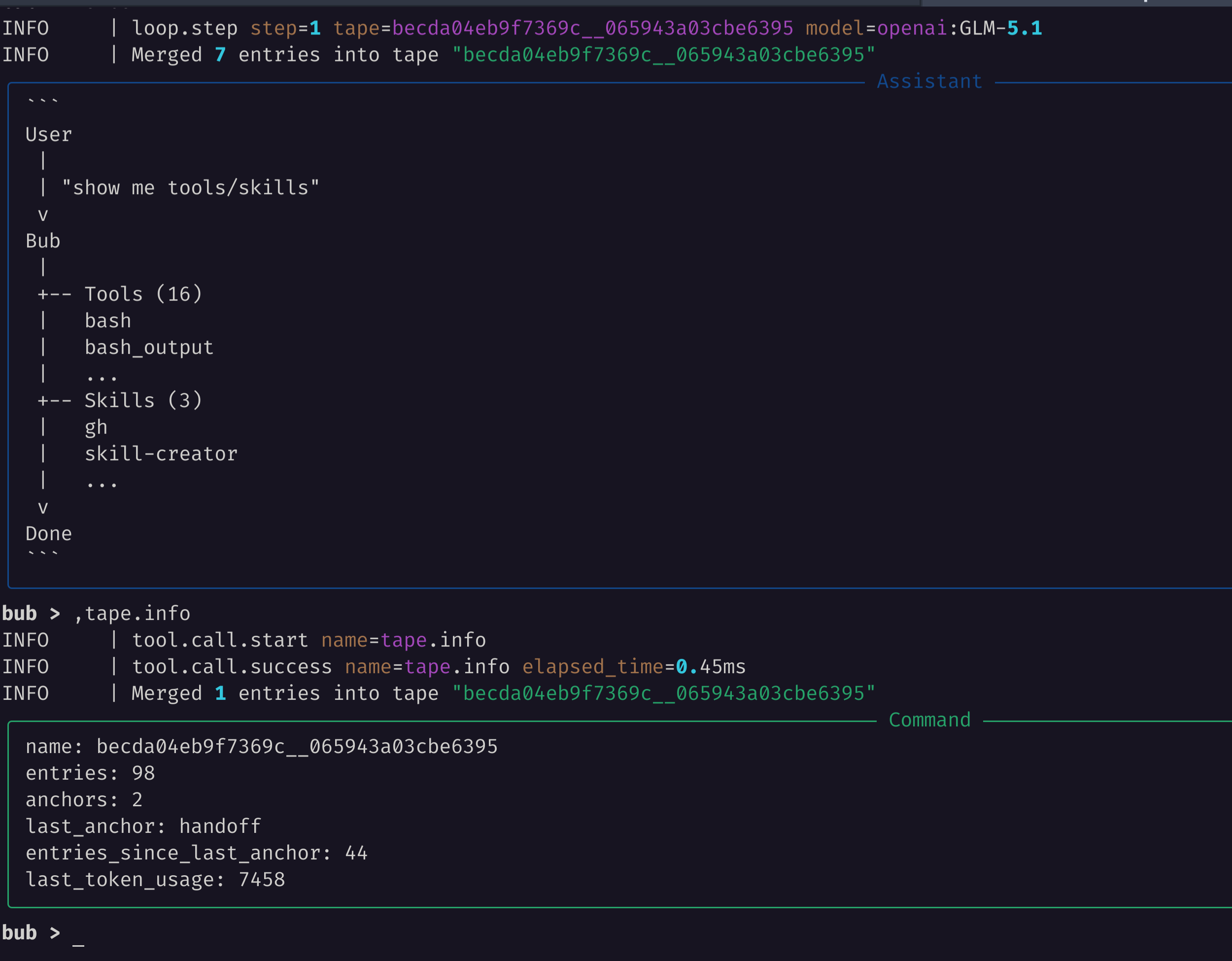
The fields are useful when the model starts behaving oddly:
entriestells you how much history the session has accumulated.anchorsandlast_anchortell you whether the tape has a checkpoint for context reconstruction.entries_since_last_anchortells you whether a handoff could shorten the next prompt.last_token_usageappears when token usage has been recorded by the model path.last_token_cache_hit_rateshows the cached share of prompt tokens for that same model call when available.
Because Bub uses the tape model from tape.systems, the runtime can inspect its own operational record. Bub can answer questions about what happened because the tape is the same state it uses to rebuild context.
2. Search the tape for symptoms
Section titled “2. Search the tape for symptoms”Use tape.search when you need to find a prior tool call, error, or handoff:
bub run ",tape.search query=loop.step"You can also ask the model to inspect the tape and explain what it sees:
bub run "Inspect the current tape and summarize the last turn."That second command may call the model, so use it only after provider credentials are configured.
3. Start Phoenix locally
Section titled “3. Start Phoenix locally”Run Phoenix with OTLP HTTP ingestion enabled:
docker run --rm --name bub-phoenix \
  -p 6006:6006 \
  arizephoenix/phoenix:latest
Open the UI:
http://localhost:60064. Run Bub with OTLP
Section titled “4. Run Bub with OTLP”Bub exports native GenAI spans directly to Phoenix using the OpenTelemetry SDK. Logfire is not required.
In another terminal, run:
OTEL_SERVICE_NAME=bub \
OTEL_EXPORTER_OTLP_TRACES_ENDPOINT=http://localhost:6006/v1/traces \
OTEL_EXPORTER_OTLP_TRACES_PROTOCOL=http/protobuf \
bub run "What tools do you have, and what small tasks are they useful for?"
Then run the local tape check with the same telemetry settings:
OTEL_SERVICE_NAME=bub \
OTEL_EXPORTER_OTLP_TRACES_ENDPOINT=http://localhost:6006/v1/traces \
OTEL_EXPORTER_OTLP_TRACES_PROTOCOL=http/protobuf \
bub run ",tape.info"
OTEL_EXPORTER_OTLP_TRACES_ENDPOINT is the complete trace URL. Alternatively, set OTEL_EXPORTER_OTLP_ENDPOINT=http://localhost:6006; the exporter appends /v1/traces. The trace-specific variable takes precedence. Bub supports http/protobuf (the default), with headers, timeouts, resource attributes, and sampling configured through standard OpenTelemetry environment variables.
An explicit OTLP endpoint selects direct export even if Logfire is installed; Bub does not also configure Logfire. Existing tracer providers are preserved, repeated initialization does not add exporters, and OTEL_SDK_DISABLED=true disables this initialization. The SDK batches exports and drains queued spans on normal process exit.
For an authenticated destination, set OTEL_EXPORTER_OTLP_TRACES_HEADERS (or OTEL_EXPORTER_OTLP_HEADERS). To select a Phoenix project, include x-project-name=my-project in those headers; otherwise Phoenix uses its default project.
5. Inspect the trace in Phoenix
Section titled “5. Inspect the trace in Phoenix”In Phoenix:
- Open the default project.
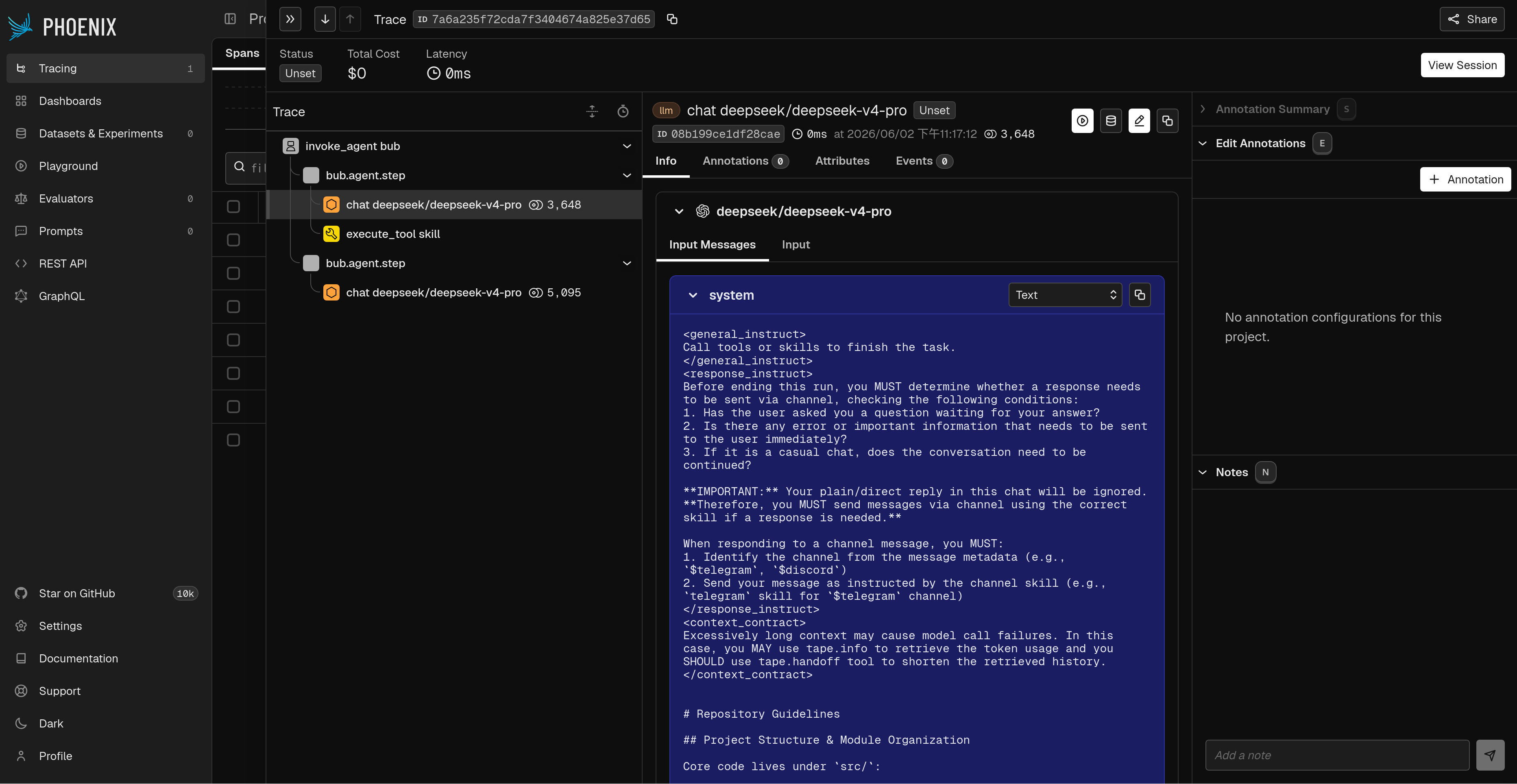
- Open the most recent trace.
- Look for
invoke_agent bub,chat <model>, andexecute_tool <tool>spans.
This path complements tape inspection:
- Tape answers “what did this Bub session remember?”
- Phoenix answers “how did this Bub agent turn run across model calls, tool calls, and tape updates?”
Use both when debugging production behavior: start with ,tape.info to understand the session state, then use Phoenix to inspect timing, errors, model calls, and tool calls.
Send trajectories to Logfire
Section titled “Send trajectories to Logfire”To send trajectories to Logfire, install the logfire extra, which includes bub[trace] and Logfire. With no explicit OTLP endpoint configured, Bub’s CLI configures Logfire at startup; no tracing plugin is required.
When switching from Phoenix, clear both OTLP endpoint variables, authenticate with your Logfire project, then run Bub:
unset OTEL_EXPORTER_OTLP_TRACES_ENDPOINT OTEL_EXPORTER_OTLP_ENDPOINT
uv pip install "bub[logfire]"
logfire auth
logfire projects use
bub run "Inspect this repository and summarize its structure."
For deployment, provide LOGFIRE_TOKEN through your environment. In Logfire’s Agents view, look for bub. Each invocation contains chat <model> and execute_tool <tool> spans. Subagents are nested under the tool that launched them, and runs in the same session share gen_ai.conversation.id.
Trace contents and lifecycle
Section titled “Trace contents and lifecycle”The spans record model inputs and outputs, tool arguments and effective results (after result hooks and spill), token usage when supplied by the provider, and errors. Inline media payloads are omitted from message telemetry. Model fallback updates the model attributes and records failed attempts as events. Token usage is recorded on model spans only, avoiding duplicate counts on agent spans.
Tape events such as loop steps, handoffs, and spill writes appear on the active span. Tape event and chat metadata contain trace_id and span_id for correlation. Tape storage remains independent of telemetry export.
Without the optional dependencies, tracing is a no-op. Installing bub[trace] alone does not enable export: configure an OTLP endpoint or supply your own tracer provider. Importing Bub does not configure telemetry. Embedders can call configure_otlp() after setting the endpoint environment variable, or configure their own provider:
from bub.tracing import configure_otlp

configure_otlp()  # Reads OTEL_EXPORTER_OTLP_TRACES_ENDPOINT or OTEL_EXPORTER_OTLP_ENDPOINT.
# Create and run Bub using your normal embedding entrypoint.
Streams expose aclose(). Embedders that may stop consuming early should use contextlib.aclosing(stream) so provider streams, tape forks, and spans close promptly. Trace context is activated only while advancing or closing a stream; it does not remain attached while consumer code handles an event. Cancellation closes spans and sets bub.cancelled; model failures and timeouts set error status.
Migrating from bub-tapestore-otel
Section titled “Migrating from bub-tapestore-otel”Use native tracing for live agent trajectories. The contrib plugin projects batches of committed tape entries into spans after the work has finished; its span timestamps describe the projection, while step duration is stored separately as an attribute. Native spans measure execution directly, preserve parallel tool timing and subagent parentage, and close on cancellation even when no terminal tape entry is committed.
The plugin remains useful when the intended observation is committed tape writes. Native tracing does not replace tape persistence or reconstruct past traces from existing tapes.
To migrate:
- Install the
traceextra for Phoenix/OTLP, or thelogfireextra for Logfire, and configure the destination as shown here. - Set
BUB_TAPESTORE_OTEL_ENABLED=falseif the contrib plugin is still installed. - Keep your existing tape backend. Native tracing does not wrap or replace it.
Native spans also include OpenInference classification, model/token, message, and tool input/output attributes for Phoenix. These compatibility attributes are separate from the standard gen_ai.* attributes. There is no separate bub.agent.step span: loop steps are events on the agent span.
See the contrib plugin implementation for the tape-projection approach.
Clean up
Section titled “Clean up”Stop Phoenix with Ctrl+C if it is running in the foreground. If it is detached, remove it:
docker rm -f bub-phoenixNext steps
Section titled “Next steps”- Tape and context — understand what Bub records and how context is rebuilt.